
Of food, marriages and patriarchy
It was well after 10pm in the night and Arhum had just returned from an event at the bride’s end before the much-awaited wedding of her sibling. She was busy talking to her relatives and filling them with updates, especially her brother who hadn’t gone to the event as a custom.
She was taking off her heavy jhumkiyan, where there was a knock at the door. Her brother rose to receive it, and all she could hear was muffled and nervous laughter. He reappeared soon holding a white plastic bag in his hand.
Turned out it was his to-be-wife’s relative at the door who had come to deliver the kheer from the event as they had forgotten to give it when they were packing the food which had to be taken home. At that moment, Arhum realized the importance as well as the contrast between the bride and groom’s family when it comes to the notion of food.
There wasn’t any need to deliver the dessert, but it had to be done because of the anxiety which hovers around food at the bride’s end. There are families who threaten to call off weddings if they are not sent with enough food or if one of the components are missing like here with the dessert that the bride’s family felt it absolutely necessary to drop it despite the brother’s protest that there wasn’t any need for it.
Food and Distress
Food plays an essential role in all moments of life but most importantly so in festivities as well as grief and being such an integral part of the celebrations, it should perhaps only bring people together as they break bread instead of causing so much apprehension. But the case is quite the opposite when the gender lens is applied to it. Arhum had witnessed her sister’s wedding as well so she knew how it felt to be in the shoes of the bride’s family and truth be told it wasn’t a walk in the park.
While she could empathise with the bride’s side now that she was at the other end of it, Arhum knew that there was also a lot which she couldn’t really do given the circumstances and the panic-struck family of the bride who wouldn’t have luxury to discuss the cons of maintaining practices which are harmful for the system in the long run.
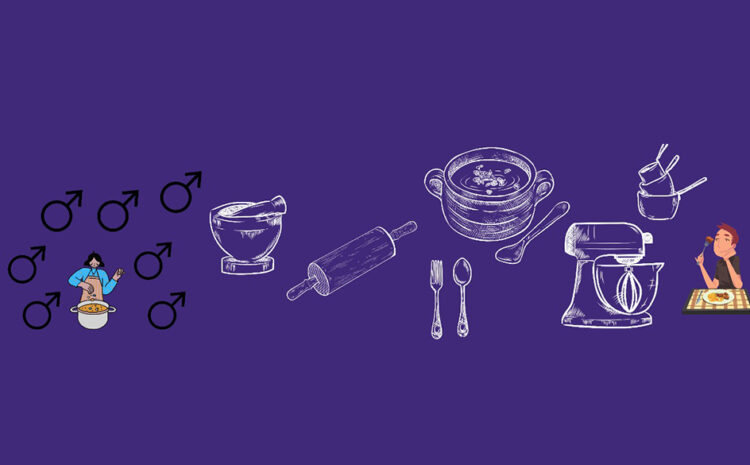
Arhum’s situation isn’t an anomaly; rather it is quite common among many households where the scent of food leads to stress on the woman’s side of the family even after the marriage has taken place. From men being served the food first while women wait to wives waiting for their husbands to finish eating so they may eat later, the practice being extended for sons and other male members, the idea of food also then rests in men having the first right over food while nonmen get what is left behind. The same power quadruples when it is bestowed upon the man who is chosen to be the groom for any woman. As soon as a consensus is reached between both families there is an invisible agreement which hangs that the woman’s family has to make sure that the groom’s family’s food needs among others are met with utmost care and attention. The groom’s family may not necessarily worry about this because they are aware that this is the way of the world, so much so that for many people there is nothing wrong with the concept, with the groom’s family expecting or demanding a certain amount of food rather this ritual is to be cherished. Sharing food with each other is perhaps one of the most beautiful aspects of any new relationship but if it is wholly one-sided then it needs to be questioned if not done away with completely.
A few years ago, Shabnam* had donned on her Mayoun dress and was happily enjoying her Mehendi when the next day her wedding was called off by her in-laws because they were not given enough food post event. Hence for those this is just an innocuous custom which may be affordable, for some it can become a fresh force of a trauma.
Royalty of the Son-in-law
Even when a man visits his in-laws there is special treatment given to him which may not necessarily be given to the daughter-in-law of the same house. It may be argued that he comes only as a guest and should be given preferential points but in many households, it is out of fear or criticism levied against the daughter in case he is not presented with food of his liking, instead of doing the same out of love. Rehana* who turned 60 recently recounted how she was forced to serve the husband of her sister-in-law who had come to visit them, something which he did quite frequently as he lives nearby. Her mother-in-law had asked her to bring a cold drink for him to which she obliged but the man suddenly changed his mind and asked for a cup of tea. Rehana returned to the kitchen to comply and upon serving him tea he responded that he didn’t feel like having any of the drinks before him because it took her a while to do so. All this when she was expecting her first child after an impactful miscarriage.
Rehana’s mother-in-law should have probably stepped up, but the deep-rooted fear of upsetting a man who is now in control of the daughter’s life, holds the majority of the people captive, and the inability to change the system goads them into believing that it is a very healthy love language.
Acknowledging that this practice of demanding to be fed by the woman’s family each time is setting a dangerous precedent for future generations can be the first step to change such moves. Alveena is one such person who realised that her grandfather treated her paternal uncle’s in-laws with extreme disrespect. Her grandfather did not only demand for the food to be sent to his home, he created a ruckus for being served beef as opposed to chicken. He escalated this so much that he cussed at his son’s in-laws and decided to call off the wedding before others intervened. Even though the wedding did take place, the in-laws, who weren’t very financially stable, had to get the wedding day’s menu changed to not upset the grandfather.
During wedding events, there isn’t a doubt that large quantities of food is saved for leftovers which is later distributed to relatives, in-laws as well as amongst the needy. However, ordering deghs just to satiate the in-laws may be going a little too over the edge more so if they don’t keep their end of the bargain. Yet no one bats an eye over this practice rather it is always such a given that a representative would come to drop an item in case it is, God forbid forgotten. Weighing the kilos of the mithai to counting the dishes, and seeing if the son-in-law is served like royalty are the few markers which determine the relationship a family has with the food pertaining to their son-in-law.
Food is always meant to be shared, and treated with love and kindness, the only stress one should get with regards to food is the knowledge that there are people who are dependent on you for food and they are sleeping hungry. Anything else than that, especially to please a family which is only trying to fill their bellies out of their egos, should be chopped up finely, and left to be dissolved over high heat for good. Patriarchy is already everywhere, it should spare the food now, which should always be given to those who have the first right over it due to their class and not mere gender.

Zoya Anwer
Zoya is a writer and a journalist from Pakistan whose interests include relationships between class, genders, faith, and borders