
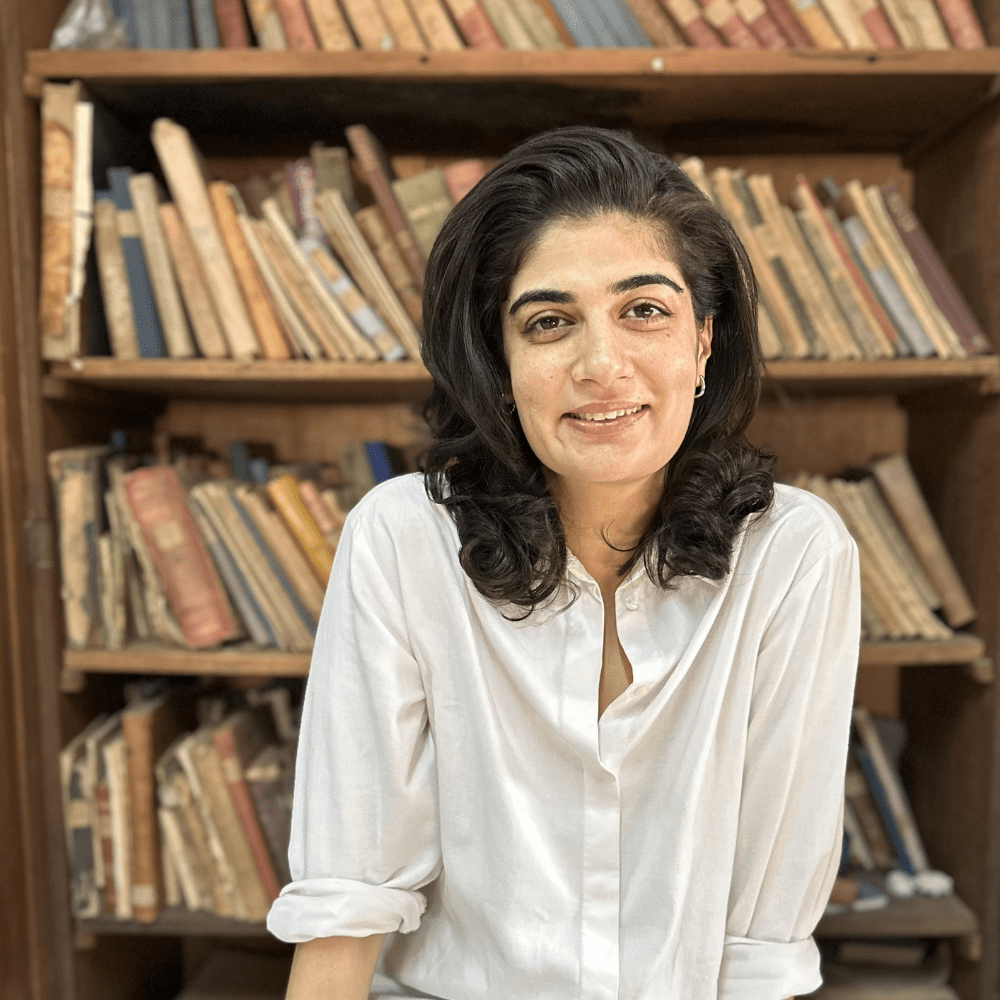
Veera Rustomji is a multidisciplinary artist from Karachi. Her practice deals with uncovering historiographical power structures portrayed through materials which explore geographical influences, religious iconography and archival methods. She holds a BFA from the Indus Valley School of Art and Architecture (IVS) and an MA from Chelsea College of Arts at the University of the Arts London (UAL), where she was awarded the UAL Postgraduate International Scholarship. Veera produced a body of documentation capturing the erasure of island life and coastal heritage within the Indus Delta for the Mead Fellowship and her site-specific investigations coexist alongside literary and community-based archives from public and private collections which examine the Zoroastrian diaspora. Veera is also the co-director of the Urban Repository Archive (URA) housed within the Department of Fine Art (IVS), which explores how student-lead research responds to the changing landscape of Karachi.
The session will highlight how Zoroastrian and Parsi women in Karachi have shaped traditions of care, philanthropy, and education within the city. Drawing on photographs, newsletters, and private family archives, the talk traces women’s roles in healthcare, schooling, research, and community organizations, past and present. It will also explore why acknowledging and archiving these histories is urgent, and what is at risk of being lost if these stories are not preserved.
This talk explores physical archives that highlight Parsi-led work in Karachi, with a focus on the community's women in the early twentieth century, a time when photography and formal documentation were limited. The images bring to the forefront how women in Karachi today continue traditions of care, research, and philanthropy through organizations such as the Karachi Zarthoshti Banu Mandal and Mama Parsi High School, as well as through materials preserved at the Dastur Dr Dhalla Library and Y.M.Z.A. Library. By looking at photographs and printed records, the talk asks where community legacy could be derived from, and why it is important to acknowledge and preserve the stories of women who might otherwise be forgotten.
Bites
Veera Rustomji is a multidisciplinary artist from Karachi. Her practice deals with uncovering historiographical power structures portrayed through materials which explore geographical influences, religious iconography and archival methods. She holds a BFA from the Indus Valley School of Art and Architecture (IVS) and an MA from Chelsea College of Arts at the University of the Arts London (UAL), where she was awarded the UAL Postgraduate International Scholarship. Veera produced a body of documentation capturing the erasure of island life and coastal heritage within the Indus Delta for the Mead Fellowship and her site-specific investigations coexist alongside literary and community-based archives from public and private collections which examine the Zoroastrian diaspora. Veera is also the co-director of the Urban Repository Archive (URA) housed within the Department of Fine Art (IVS), which explores how student-lead research responds to the changing landscape of Karachi. The session will highlight how Zoroastrian and Parsi women in Karachi have shaped traditions of care, philanthropy, and education within the city. Drawing on photographs, newsletters, and private family archives, the talk traces women’s roles in healthcare, schooling, research, and community organisations, past and present. It will also explore why acknowledging and archiving these histories is urgent, and what is at risk of being lost if these stories are not preserved. This talk explores physical archives that highlight Parsi-led work in Karachi, with a focus on the community's women in the early twentieth century, a time when photography and formal documentation were limited. The images bring to the forefront how women in Karachi today continue traditions of care, research, and philanthropy through organisations such as the Karachi Zarthoshti Banu Mandal and Mama Parsi High School, as well as through materials preserved at the Dastur Dr Dhalla Library and Y.M.Z.A. Library. By looking at photographs and printed records, the talk asks where community legacy could be derived from, and why it is important to acknowledge and preserve the stories of women who might otherwise be forgotten.