
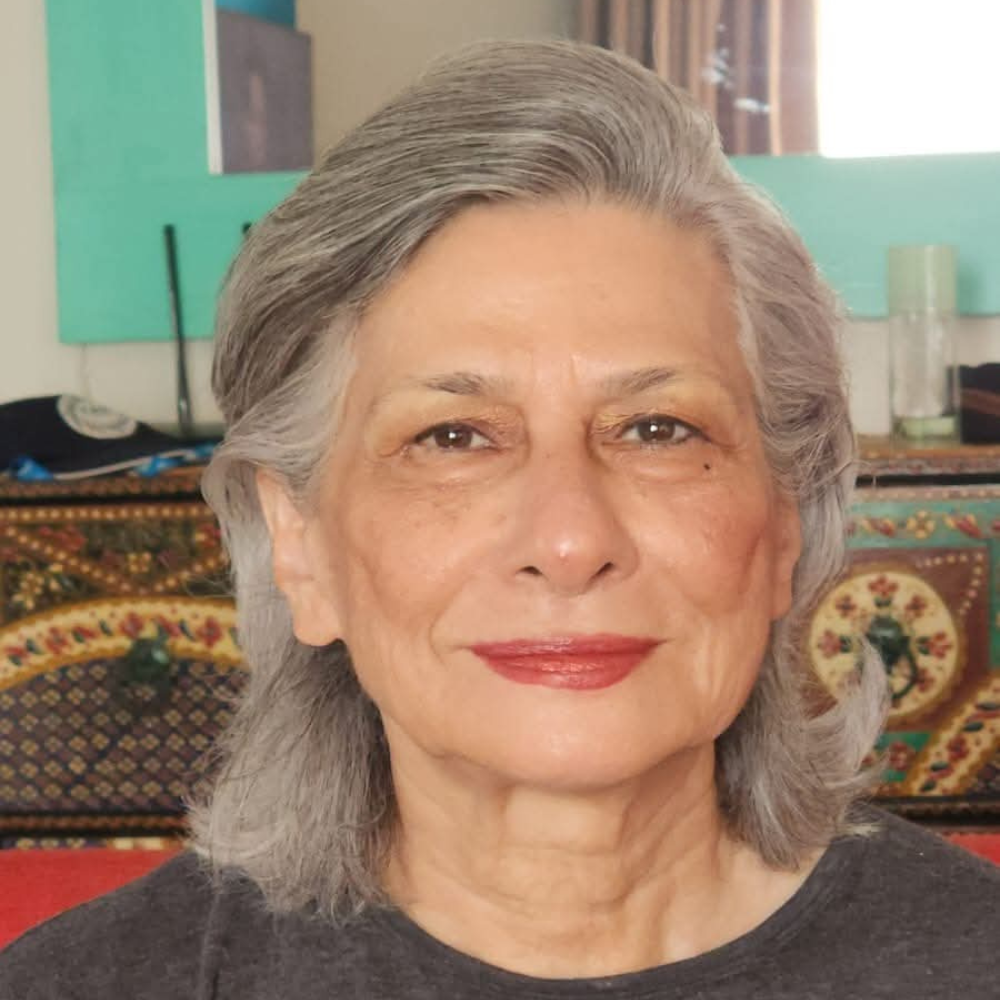
Mahnaz Rahman is a senior writer, journalist and activist. Till June 2024, she had been working as Resident Director at Aurat Foundation’s regional office based at Karachi, a role she took on in 2010. Currently she works as a freelance policy analyst and consultant. She is a known practitioner on women rights and socio political issues having a journalistic background which adds to her strengths in terms of networking, liaison and communication with media, civil society, political parties and parliamentarians. She has been serving as development practitioner and has acquired versatile skills in terms of trainings on human right advocacy, developing research papers and technical backstopping on programme development aspects. Her experiential background while working with diverse institutions ranging from media, Aga Khan University and Church World Service significantly contributed to attain the desired set of skills and competencies to serve her last full time leadership role as Resident Director at AF.
MsMahnaz has extensive international exposure in terms of attending international conferences, trainings and a delegation meeting held around international human rights charters and conventions and human right advocacy and thus has visited number of countries including Bangkok, Brussels, New York, Hague, Afghanistan, Srilanka and Eastern Mennonite University, Harrisonberg, USA. She attained high level honours during her academic and professional life in terms of being the First female President of the employees union of a newspaper and senior joint secretary of KUJ (Karachi union of journalists) for two terms in 1983-84 and also has the honor of being awarded the Friendship Medal by the Prime Minister of People’s Republic of China (Li Peng) in 1991 for promoting friendship of two countries through her writings. She got life time achievement award from Government of Sindh’s Commission on Status of Women in 2020.
panel
This opening conversation brings together powerful women leaders from across sectors to deliver 10 minute reflections on what the last decade has changed, what it has cost, and what is now at stake. These are not speeches shaped by consensus or caution, but first words: direct, personal, and grounded in power, loss, and possibility. Together, the voices form a shared reckoning with the present moment, naming hard-won gains, unfinished struggles, and the growing forces pushing back against gender justice. The session then flows into a moderated conversation, connecting experiences across movements and generations and pressing toward what comes next. This is where the festival begins: with clarity, urgency, and a feminist vision for the decade ahead